
The Garden as Living Art: On Mineral, Plant, and the Ephemeral
What if the garden were not an ornament to life, but one of its most radical artistic propositions — an artwork that breathes, decays, and returns?
Stone Before Leaf: The Grammar of the Mineral
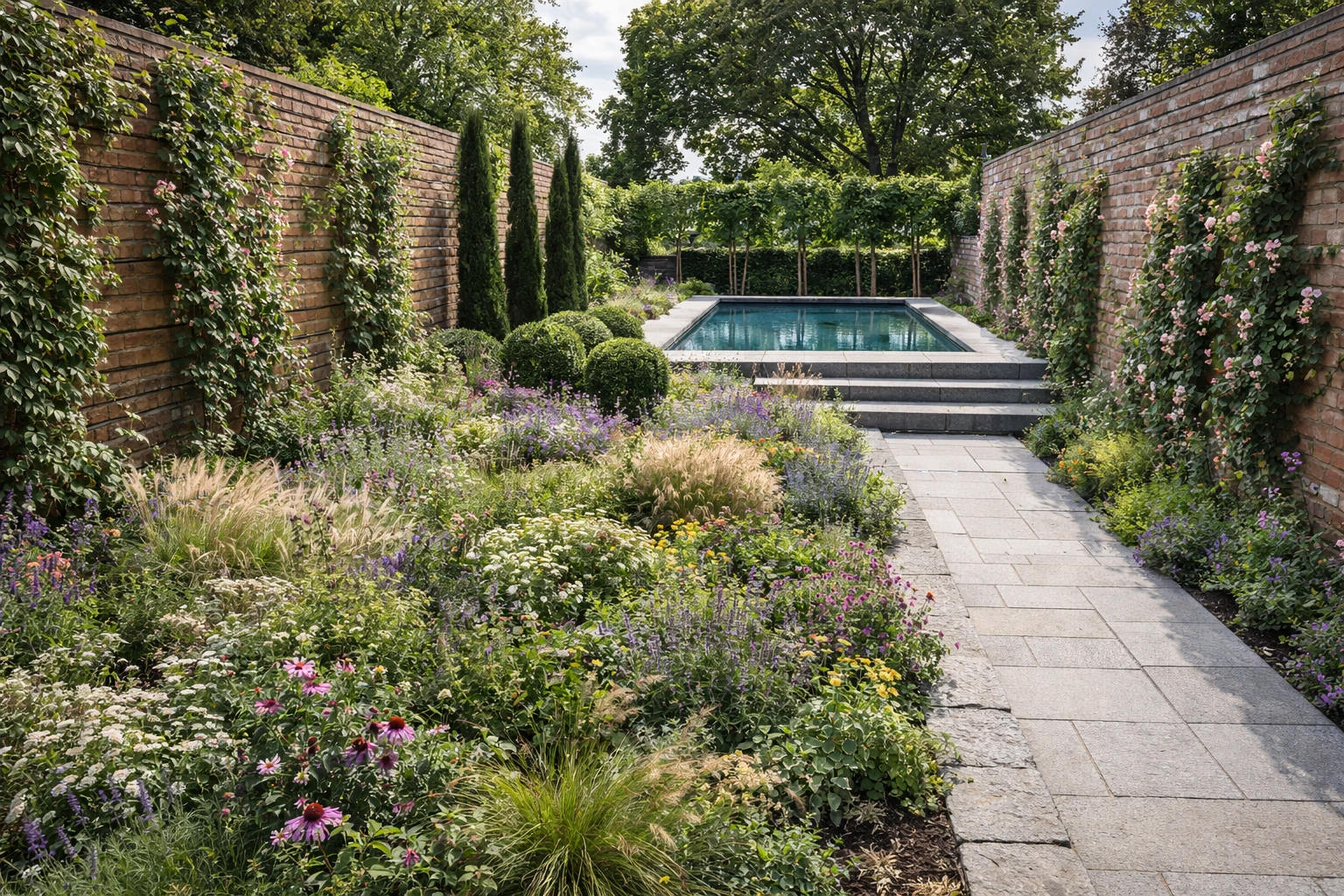
Every serious garden begins before any seed is placed in the ground. It begins in the resistance of stone, in the permanence of a dry-laid wall, in the careful geometry of a terrace carved from a hillside. The mineral layer is not an infrastructure — it is a statement. It is the artist's first mark, drawn not in pigment but in mass and gravity.
There is a reason that the great gardens of history — from the Alhambra's interlocking geometries to the philosophical silence of Ryōan-ji — are remembered first as compositions of stone and water, not of flowers. The mineral endures across seasons, across centuries. It provides what no herbaceous planting can: a continuous, legible structure against which time makes itself visible. The lichen that slowly colonises a granite boulder is not a blemish — it is the garden telling its own age, like rings within a trunk.
In contemporary garden-making, the use of raw stone — rough-hewn basalt, local limestone, reclaimed brick, gravelled terraces — speaks of a refusal of the purely decorative. It grounds the project in geology, in the specific memory of a place. A terrace laid in the same stone that underlies the soil beneath it achieves something rare in art: it makes the invisible visible. The garden becomes a section through the earth itself, an archaeological proposition.
"The mineral layer is not a background to the garden. It is its skeleton, its conscience — the element that refuses to perform."
And yet the mineral is never inert. Placed with intentionality, a single irregular slab of schist becomes a resting point for the eye, a caesura in a flowing composition. Steps that descend in irregular risers invite the body to slow, to be present. A dry-stone wall offers texture at every scale — rough from a distance, complex and inhabited up close, sheltering mosses, ferns, and invertebrates within its joints. This is art that lives.
The Green Architecture: Hedges as Spatial Language
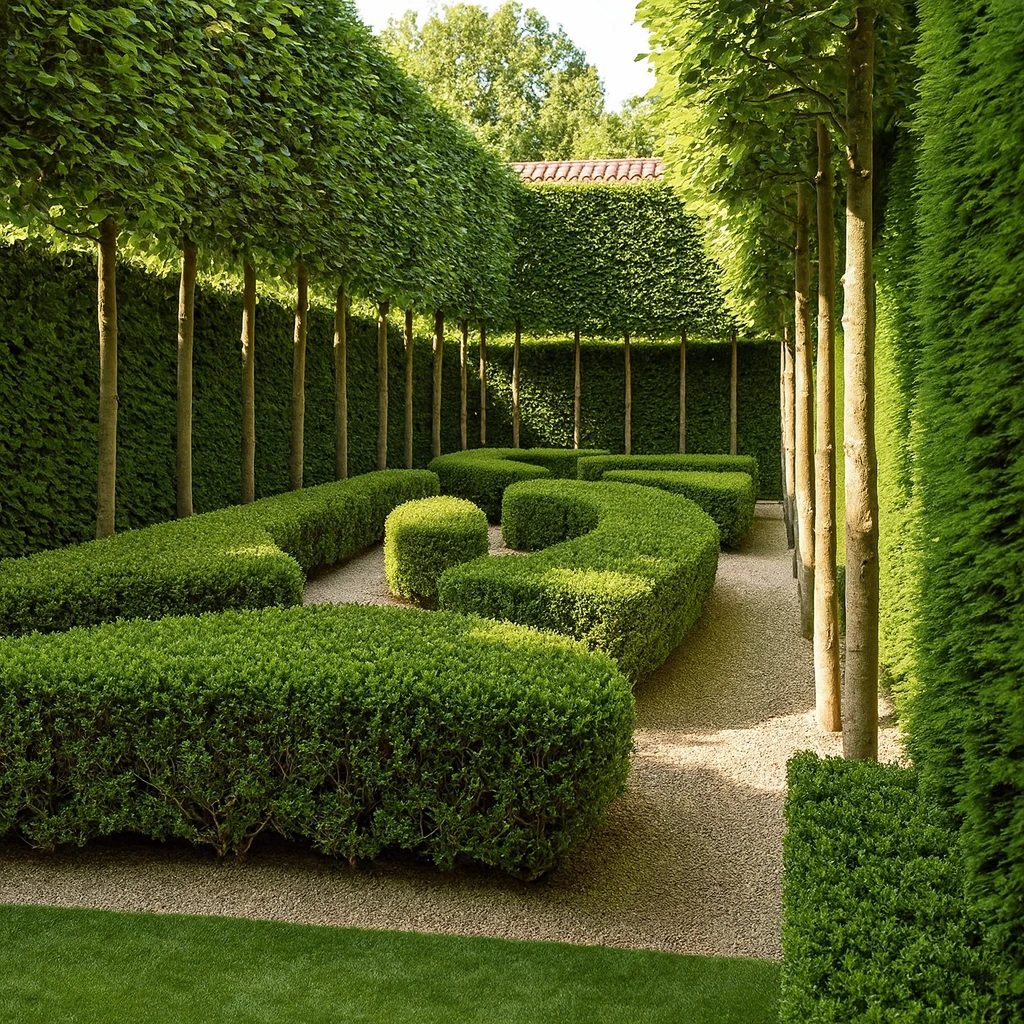
If mineral provides the horizontal — the terrace, the path, the edge — then the persistent hedge provides the vertical. And here, too, we enter an artistic territory far richer than the merely practical. The hedge is one of the oldest and most sophisticated spatial tools available to the garden designer: a living wall that filters light rather than blocking it, that breathes with the seasons while retaining its essential form.
The clipped yew, the hornbeam, the evergreen box — these are not merely boundaries. In the hands of a thoughtful designer, they become the walls of an outdoor room, framing views with a precision that recalls the picture plane. They create compression and release. Passing through a narrow gap in a tall hornbeam hedge into an open meadow is an experience as carefully orchestrated as entering a cathedral nave: the darkness and enclosure, and then the sudden flood of light and space.
What is crucial to understand is that these structures are alive in a way that stone is not. They must be maintained, and that maintenance is itself an artistic act — a collaboration between designer and the growth of the plant. The sheared yew plane does not stay flat without intervention; it presses outward, asserting its own biological programme. To work with it is to enter into a dialogue with time that no other medium offers. The sculpture breathes back.
"A hedge does not merely divide space. It holds it — and in doing so, it creates the silence necessary for other presences to be felt."
The Living Landscape: On Piet Oudolf, Tom Stuart-Smith, and the Philosophy of Impermanence
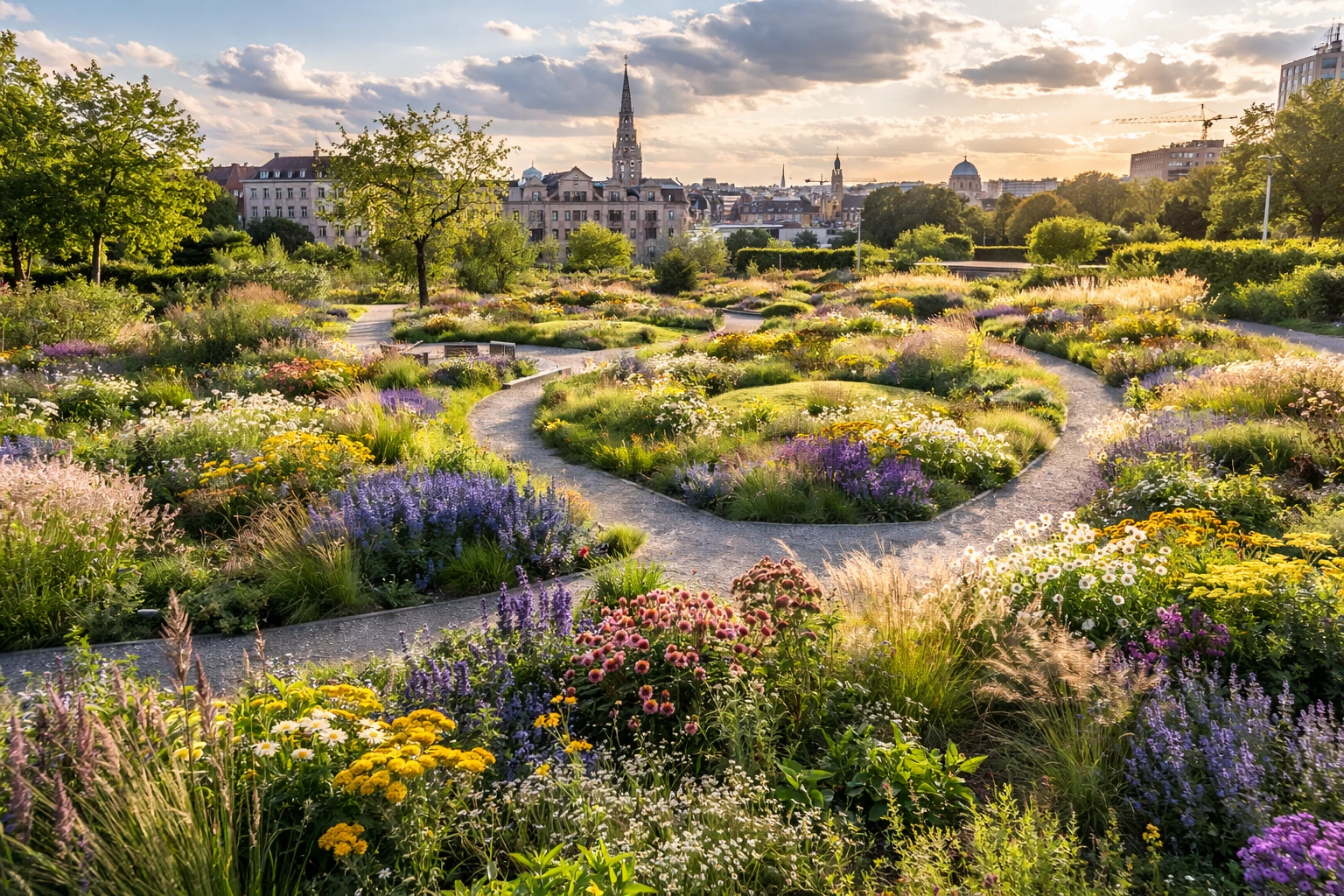
Within the structural framework of mineral and hedge, the third register of the garden opens — and it is here that contemporary garden art has made its most provocative intervention. The New Perennial Movement, associated above all with the practice of Piet Oudolf, proposed something philosophically startling: that beauty need not be stable, and that the moment of decay is as worthy of attention as the moment of bloom.
Oudolf's planting — sweeping masses of grasses, sedums, rudbeckias, and persicarias — is designed to be beautiful across all twelve months. The spent seedhead in November carries as much visual weight as the midsummer flower. The bleached, frost-rimed skeleton of a Molinia in January is not a failure; it is a carefully anticipated stage in a continuous composition. This requires of the garden visitor a different mode of attention: not the glance of the tourist seeking a postcard view, but the slow gaze of someone willing to read a landscape as it changes through time.
Tom Stuart-Smith works in a related but distinct register, combining deep horticultural knowledge with a painter's eye for tone and texture. His gardens — whether the intimate spaces of his own property at Serge Hill or the expansive meadow plantings at Chatsworth — are distinguished by a quality of layered softness: the way mid-height grasses allow distant hedges to read through them, the way the tonal contrast between silver foliage and dark yew creates depth across a long view. His work is fundamentally about the relationship between the garden and its wider landscape — the integration, rather than the separation, of cultivation and wilderness.
Both Oudolf and Stuart-Smith understand something essential about the nature of living art: it cannot be controlled, only guided. Every planting scheme is a hypothesis, not a blueprint. The plants respond to soil, to microclimate, to competition from neighbours, to the unpredictable intensities of each particular year. The designer must be willing to observe, to adjust, to let go. In this, the garden demands a humility that few art forms require.
Umilys: Where Expertise Meets Artistic Vision
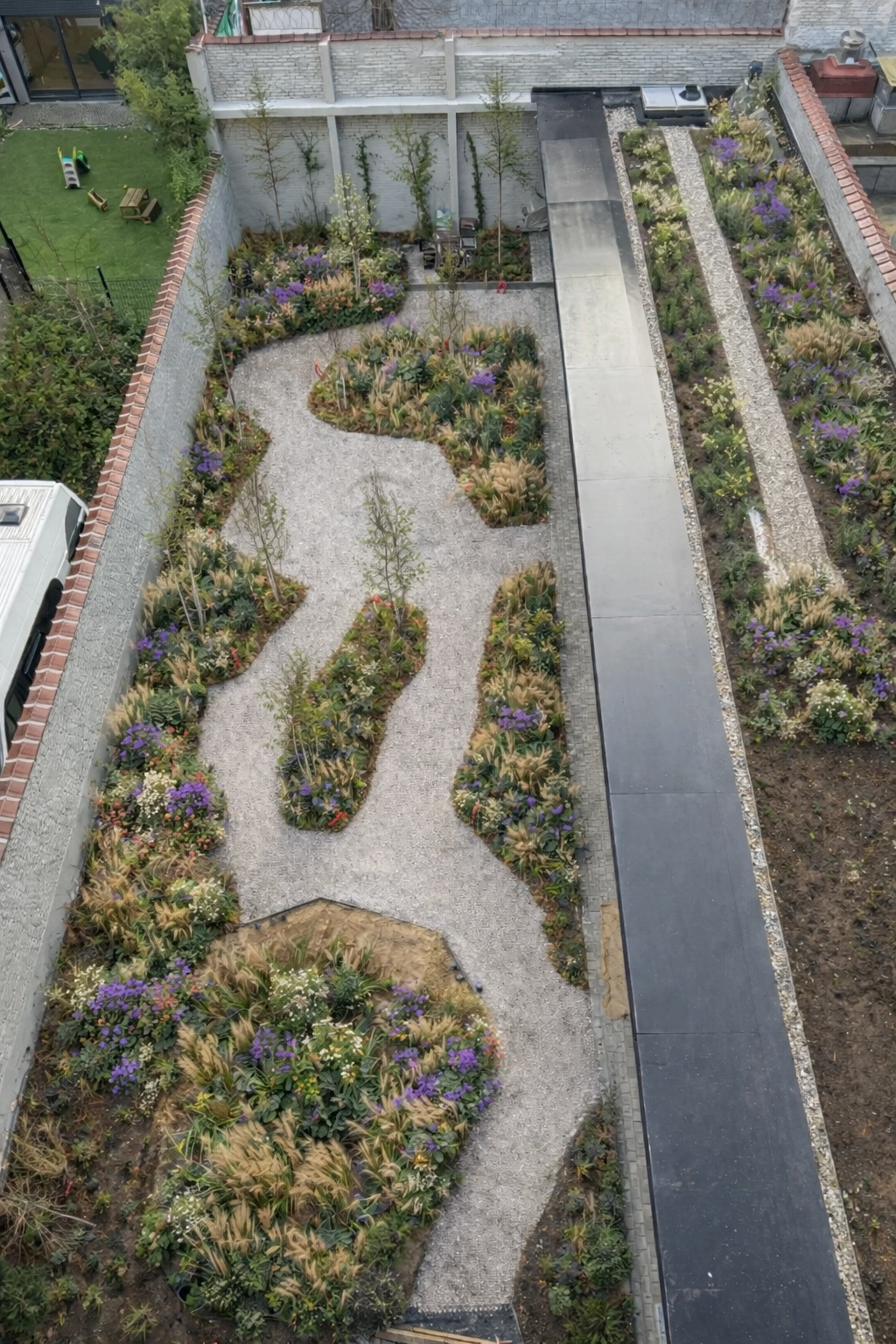
It is in this context that the work of Studio Umilys deserves particular attention. Positioned at the intersection of ecological rigour and spatial sensibility, Umilys represents a current in contemporary Belgian and European garden design that takes seriously both the artistic ambitions of the New Perennial tradition and the specific demands of regional ecology. Their practice — further developed through the resources of Architecte-paysagiste.be — engages with questions that go beyond aesthetics: questions of biodiversity, of soil health, of the relationship between a designed landscape and the broader ecological matrix in which it sits.
To design a garden informed by this sensibility is to accept that the artwork is never finished. It is, in the deepest sense, a process rather than a product. The planting evolves; certain species establish while others retreat; self-seeders appear where they were not planned, sometimes more felicitously than anything the designer might have chosen. The garden in this mode is collaborative — between designer, client, plant, and the specific genius loci of the place.
This is a radically different relationship to artistic authorship than that which prevails in the studio arts. The painter can return to find her canvas as she left it. The garden designer returns to find a conversation ongoing — one that began with her first decisions about soil preparation and mineral structure, and that will continue long after her direct involvement has ended.
The Philosophical Question: What Kind of Art Is This?
The garden resists easy categorisation within the history of art, and perhaps that resistance is its most interesting quality. It is not an object — it cannot be bought and hung. It is not a performance — it does not unfold between a fixed beginning and a fixed end. It is not architecture — though it borrows architecture's tools of space and enclosure. It is, perhaps, closest to music: an art of time, in which individual elements gain meaning through their relationships and their succession.
But unlike music, the garden is not repeatable. No two visits offer the same experience, and this irreproducibility is constitutive of its meaning. The quality of morning light on a frost-covered ornamental grass is not a variable to be eliminated — it is the substance of the experience. The garden art object is therefore, in a profound sense, impossible to document. The photograph captures a fragment; the memory retains an impression; the garden itself continues to change, indifferent to representation.
This places the garden in an interesting position relative to the contemporary art world's preoccupations with the ephemeral, the site-specific, and the relational. The garden is all three simultaneously — and has been for millennia, without requiring the theoretical apparatus that these categories have attracted in the gallery context. In this sense, the garden is not a form of art that is trying to become something else. It is fully itself: patient, seasonal, radically present, and entirely impossible to possess.
"To make a garden is to accept that time will be your collaborator, that loss will be part of the composition, and that the most perfect moment will always be the one you were not present to see."
At Art for Garden, we hold this understanding as foundational. The objects and artworks we curate — whether sculptures intended to anchor a view, ceramic vessels that hold the memory of fire in a garden of living things, or pots that bring mineral weight and texture into dialogue with planting — are chosen in the full knowledge of where they will be placed. Not in a neutral white cube, but in the most complex, most alive, most philosophically demanding exhibition space that exists: the garden itself.